

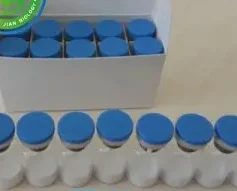
Hexarelin Muscle Building Peptides For Fat Loss Hasten Parturition CAS 140703-51-1

Product Name: Hexarelin
Synonyms: Examorelin
CAS: 140703-51-1
MF: C47H58N12O6
MW: 887.04
Purity (HPLC): 98.0%
Appearance: White powder
Single Impurity (HPLC): 0.5%max
Amino Acid Composition: ±10% of theoretical
Peptide Content (N%): ≥80.0%
Water Content(Karl Fischer): ≤8.0%
Acetate Content(HPIC): ≤10.0%
Hexarelin is a synthetic GH secretagogue, structurally similar to GHRP-6, which is in the growth factor family known as Growth Hormone Releasing Peptides or GHRPs. The results of several studies conducted on both mice and rats has led to the conclusion that Hexarelin is one of the most powerful GH-Releasing Peptides. Hexarelin, unlike GHRP-6, does not increase appetite because of its inability to drastically increase Ghrelin levels, which is responsible for the increased appetite and quicker gastric emptying. Hexarelin is a synthetic growth hormone secretagogue made from six amino acids.
Hexarelin has a peptide purity level that exceeds 99.0% as determined by HPLC. This peptide was synthesized with no additives and is supplied as a white lyophilized (freeze-dried) powder.
Hexarelin (HEX) is a peptide GH secretagogue, structurally similar to GHRP-6, in the factor family which stimulates the release of growth hormone (GH). Hexarelin can be used medically to treat GH deficiency. Hexarelin is becoming a popular choice as a performance enhancement drug.
Due to Hexarelin’s ability to increase secretion of natural Hormone, most of its effects are similar to those of synthetic GH, although to a slightly lesser extent.

Hexarelin (Hexarelin Acetate) is chemically designed as L-Histidyl-2-methyl-D-tryptophyl-L-alanyl-L-tryptophyl-D-phenylalanyl-L-lysinamide. Hexarelin (Hexarelin Acetate) is a potent GHRP-6 analog, whose structure (His-D-2-methyl-Trp-Ala-Trp-D-Phe-Lys-NH2) creates a greater stability than GHRP-6 due to a substituted (2 Me)Trp. Hexarelin has a half-life of about 70 min, longer than that of GHRP-6. Replacement of the naturally occurring L-amino acids for the D-configuration results in these longer half-lives.
Hexarelin is an appetite-regulating factor secreted from peripheral organs that is involved in regulation of energy homoeostasis via binding to the receptor resulting in the secretion of by the pituitary gland.The pathway activated by binding of Hexarelin to the secretagogue receptor,GHSR1a, regulates the activation of the downstream mitogen-activated protein kinase, Akt, nitricoxide synthase, and AMPK cascades in different cellular systems.
One of the important features of GHSR1a displays constitutive activity possessing basal activity in the absence of an agonist, resulting in a high degree of receptor internalization as well as of signaling activity.Inverse agonists for the Hexarelin receptor could be particularly interesting for the treatment of obesity.This activity seems to provide a tonic signal required for the development of normal height, probably through an effect on the GH axis
Hexarelin has shown that it is highly stimulated at 30 minutes after being induced by rapid and sustained GH secretion. The pituitary gland produces GH in the brain, in children this hormone helps them to grow and in adults it helps to maintain muscle and burn fat. In one sixteen-week study, it has been shown that GH levels return to normal after stopping use after four weeks.
Reviews
There are no reviews yet.