

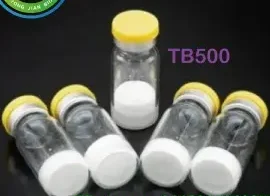

TB500 Healing Injuries Muscle Building Peptides TB500 Thymosin Beta 4 Acetate CasNO.885340-08-9
Product Name: TB500
Alias: Thymosin beta 4 acetate
CAS: 77591-33-4
MF: C212H350N56O78S
MW: 4963.49
Purity (HPLC): 95%min
Single Impurity (HPLC): 2.0%max
Amino Acid Composition: ± 10% of theoretical
Peptide Content (N%): >= 80.0%
Water Content(Karl Fischer): <= 5.0%
Acetate Content (HPIC): <= 15.0%
MS(ESI): Consistent
Mass Balance: 95.0~105.0%
Appearance: White powder
Specification: 2mg/vial,10vials/box
TB-500 is different from other repair factors because it promotes endothelial and keratinocyte migration. It also does not bind to the extracellular matrix and has a very low molecular weight.Because of this it can travel long distances through the tissues in the human body.
TB-500 is a synthetic fraction of the protein thymosin beta-4, which is present in virtually all human and animal cells. The main purpose of this peptide is to promote healing. It also promotes creation of new blood and muscle cells. The healing effects of TB-500 have been observed in tendons, ligaments, muscle, skin, heart, and the eyes. Thymosin beta-4 is naturally produced in higher concentration where tissue has been damaged. This peptide is also a very potent anti-inflamatory agent.
TB-500 is a short peptide segment or fragment of the naturally-occurring thymosin beta-4 hormone (TB-4.) To be clear, TB-500 most emphatically is not TB-4, although it’s often sold under that name. TB-4 itself is as yet an extremely pricey, rare research material that is not yet available to bodybuilding or to equine enhancement.
In the body, TB-4 is produced is the thymus, a gland which is at its largest in children, atrophies as adulthood progresses, and is virtually non-existent in the elderly. It is also produced locally in various cells, and is particularly found in wound fluids, as well as in fairly high concentration in the cytoplasm of some cells. In various studies, TB-4 has been found able to promote various forms of wound healing, to promote differentiation of stem cells, and to reduce inflammation.
Protein hormones such as TB-4 do not bind in their entirety to a receptor site, as they are too large to fit. Instead, an active region of the protein fits into receptor sites.
The TB-500 peptide sequence is identical with the active region area of TB-4 and shares many and possibly all of the properties of TB-4, in a form which is more economical to produce.
TB-500 is typically provided as lyophilized (freeze-dried) powder in vials of 2.0 mg. A convenient amount of sterile or bacteriostatic water will be added, such as 1.0 mL. In the most common dosing protocol, the entire vial is taken at one time. If taking the entire vial, the entire amount will be drawn into a syringe, typically an insulin syringe, and injected. Injection may be subcutaneous, intramuscular, or intravenous, according to personal preference.
The most common dosing protocol is to take 2.0 or 2.5 mg of TB-500 twice per week for four to six weeks, and then reduce to a lower dosing rate such as once or twice per month for maintenance.
The body of knowledge is as yet limited with regard to TB-500 dosage. The above protocol may or may not be the most efficient, but it is the protocol with the most track record. It’s entirely possible that as knowledge is gained, method of use will change. A reasonable possibility, for example, is to increase dosing frequency to 3x/week (which I have done personally to good effect), or to increase dosing to 4 or 5 mg twice per week. Before going to such a program, however, I recommend trying the standard protocol first.
If interested in animal uses, a typical dosing protocol for horses is a course of six 10 mg injections at 7-10 day intervals. For more intensive treatment, 20 mg is used weekly. For racing dogs, a typical protocol is a course of six 5 mg injections taken weekly.
TB-500 is a synthetic fraction of the protein thymosin beta-4, which is present in virtually all human and animal cells. The main purpose of this peptide is to promote healing. It also promotes creation of new blood and muscle cells. The healing effects of TB-500 have been observed in tendons, ligaments, muscle, skin, heart, and the eyes. Thymosin beta-4 is naturally produced in higher concentration where tissue has been damaged. This peptide is also a very potent anti-inflamatory agent.
• Endothelial (blood vessels) cell differentiation
• Angiogenesis (growth of new blood cells from pre-existing vessels) in dermal tissues
• Keratinocyte migration
• Collagen deposition
• Decreases inflammation of tissue in joints
• Increase muscle growth with huge increases in endurance and strength noted
• Relaxed muscle spasm and improved muscle tone
• Increase the exchange of substance between cells
• Encourage tissue repair
• Stretches connective tissue and helps maintain flexibility
• Prevents the formations of adhesions and fibrous bands in muscles, tendons and ligaments.
Reviews
There are no reviews yet.